
Every Breath You Take Is a Transaction Your Lungs Are Losing
Right now, with every inhale, your lungs are negotiating with the modern world.
Vehicle exhaust. Industrial emissions. Wildfire smoke drifting across continents. Indoor air pollutants from cleaning products, synthetic carpets, and paint. Second-hand cigarette smoke absorbed in passing.
The average person takes approximately 22,000 breaths per day.
That’s 22,000 opportunities for your respiratory system to absorb something it was never designed to process.
And here’s the uncomfortable truth nobody’s addressing loudly enough:
Your lungs have no exit strategy for most of it.
What Air Pollution Actually Does Inside Your Lungs
Unlike the liver — which has remarkable regenerative capacity — lung tissue that sustains chronic damage from pollution and toxins doesn’t simply bounce back.
Fine particulate matter (PM2.5), the microscopic pollution particles found in urban air, cigarette smoke, and industrial environments, are small enough to penetrate deep into lung tissue and enter the bloodstream directly.
Over time, this accumulation triggers:
- 🫁 Chronic inflammation of the bronchial lining — the starting point of asthma, bronchitis, and COPD
- 🫁 Mucous overproduction — the body’s defensive response, creating congestion that restricts airflow
- 🫁 Oxidative stress — accelerating cellular deterioration throughout the respiratory tract
- 🫁 Immune suppression in lung tissue — leaving the airways increasingly vulnerable to infection
- 🫁 Bronchiole constriction — narrowing the very passages your breath depends on
The worst part?
Most of this damage accumulates silently over years before symptoms become undeniable.
The Desert Shrub That’s Been Fighting This Battle for Centuries
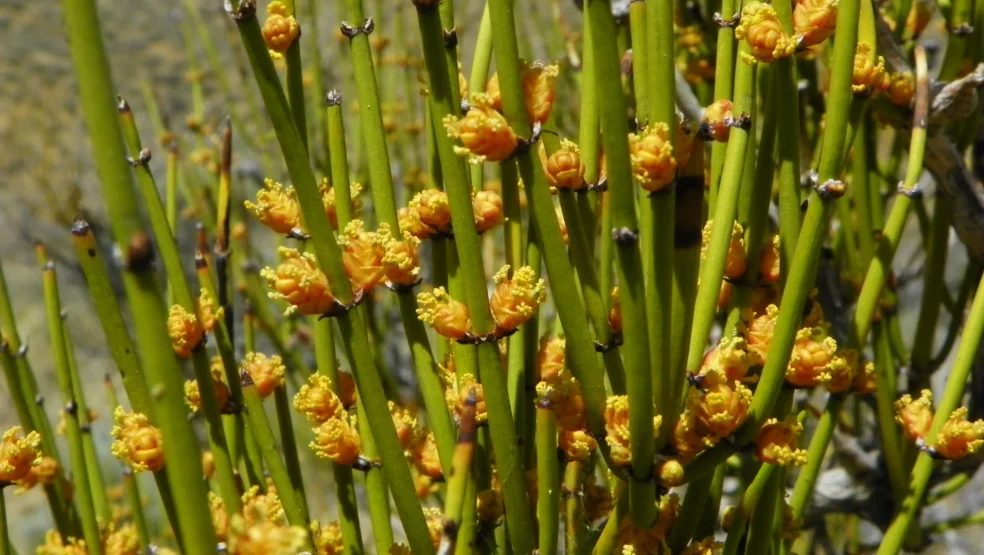
Brigham Tea. Ephedra nevadensis.
A hardy, leafless shrub that grows across the arid desert landscapes of North America — and one of the most historically significant respiratory herbs that modern herbalism consistently returns to when exploring herbs that protect lungs from pollution and environmental toxin exposure.
Long before urban pollution was a concept, Native American communities understood precisely what this plant could do for the respiratory system.
And the mechanism behind it is both elegant and remarkably direct.
How Brigham Tea Defends Your Respiratory System
As a cornerstone of Brigham tea lung protection toxins protocols in traditional botanical medicine, the herb works through its naturally occurring alkaloid compound — ephedrine — alongside a complex of supportive phytochemicals:
- 🌿 Bronchodilation — ephedrine directly widens the bronchioles, creating more airway space and improving oxygen exchange — critical for those in high-pollution environments
- 🌿 Decongestant action — reduces mucous secretions caused by chronic pollutant exposure, clearing the passages that congestion has narrowed
- 🌿 Astringent properties — tightens and tones inflamed respiratory tissue, reducing the swelling response triggered by airborne irritants
- 🌿 Central nervous system stimulation — increases respiration depth and rate, supporting more efficient toxin elimination through breathing
- 🌿 Antioxidant support — helps neutralise oxidative damage caused by sustained particulate matter exposure
This combination is exactly why traditional healers reached for Brigham Tea specifically when lungs were under environmental assault — and why it remains central to any credible conversation around natural lung detox air pollution approaches today.
Why Brigham Tea Works Best With Botanical Support
The most effective approach to clean lungs naturally from smoke herbs isn’t a single herb working in isolation.
Brigham Tea, combined with synergistic expectorants like Elecampane Root, Horehound Leaf, Coltsfoot Leaf, and Licorice Root, creates a comprehensive respiratory environment where:
Accumulated toxins are actively expelled.
Inflamed airways are soothed and reopened.
The immune defences of the respiratory tract are reinforced.
The lungs stop absorbing the damage silently — and start responding to it.
Your Lungs Have Been Absorbing the Modern World So You Can Keep Moving
Every commute. Every smoky room. Every city sunrise breathed in without a second thought.
Your lungs have handled all of it — quietly, without complaint.
Always consult your healthcare provider before beginning any herbal supplementation.